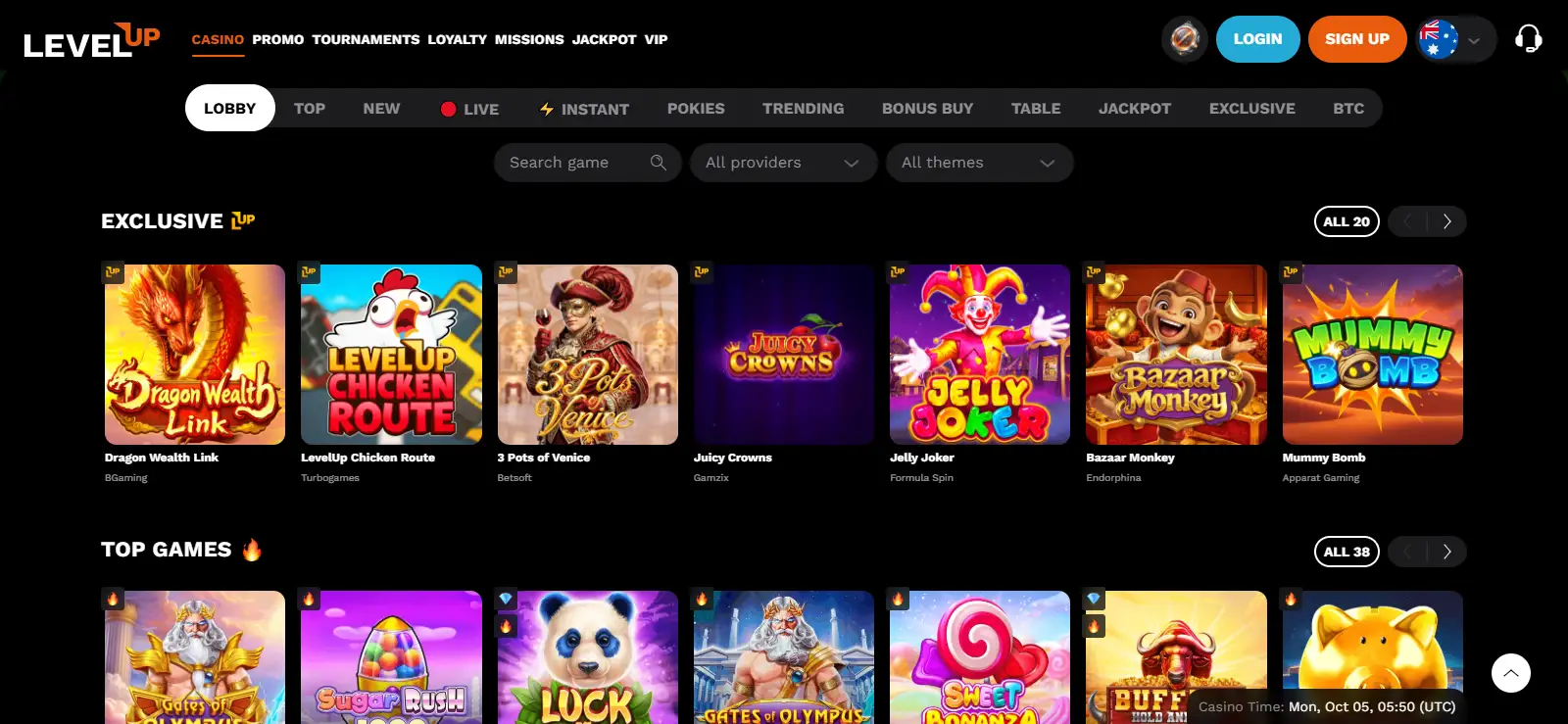

LevelUp Casino games, slots and live tables
 Available in AU
LevelUp Casino’s international lobby brings together pokies and other slots, classic casino tables, live dealers, jackpots and occasional crash titles. The game type and the rules of an individual title matter more than a headline lobby count when comparing session pace, stakes and long-run risk.

Table of Contents
- Slots, table games and jackpot formats in the lobby
- How the live-dealer selection changes the pace
- What the catalogue figures mean
- The software studios behind the international mix
- What RTP, volatility and session length actually measure
- Questions about game formats and software
- A broad lobby with different types of session risk
Slots, table games and jackpot formats in the lobby
LevelUp Casino’s international game catalogue combines slots or pokies, roulette, blackjack, baccarat, jackpot titles and occasional crash games. These categories differ in the decisions a player makes, the rate at which stakes can be committed and how a single round finishes. A lobby count groups them together, yet a session of automated slots has a different rhythm from a live table where a dealer must complete each round.
Slots use programmed reels and paytables. A result follows the rules of the particular title; different themes or animated features do not by themselves tell a player how much the game returns over time. Jackpot games add another layer because an advertised top prize and the probability of reaching it are separate matters. In particular, the possible jackpot size says little about the likelihood of a payout in any one session.
The traditional table group includes roulette, blackjack and baccarat. Their rules determine whether a round involves selections, strategy decisions or a fixed betting choice. A blackjack table may ask the player to choose between standing and taking another card; a roulette round resolves a selected number or group of outcomes. Those mechanical differences are more useful when comparing games than a generic label such as “table game”.
- Slots and pokies: repeated automated rounds with game-specific paytables and feature mechanics.
- Table games: roulette, blackjack and baccarat, with different decision points and payout structures.
- Jackpot titles: games that add a separate prize feature to the underlying round.
- Crash games: a distinct timing-and-exit format among the occasional categories in the international catalogue.
A crash game changes the pace of decision-making because its outcome can turn on when a round ends or when a participant exits. That description applies to the format generally; it does not establish that LevelUp Casino creates any of those titles itself. The distinction between game type and game ownership also matters when examining developer credits, rules and dispute responsibility.
The monetary route into a game is a separate consideration. The international payment-method comparison covers card, wallet and cryptocurrency characteristics, including the extra price and transfer exposure of crypto. None of those payment mechanisms alters the mathematics of a game’s paytable. A fast payment and a fast-paced slot are different kinds of convenience and risk.
How the live-dealer selection changes the pace
LevelUp Casino lists live blackjack, baccarat, roulette and live-show formats in its international lobby. Evolution Gaming and Ezugi appear among its live-dealer suppliers. The defining feature of this category is a filmed studio or table with a human presenter or dealer, usually paired with a digital betting interface. That creates a different experience from a slot round generated and displayed entirely on the device.
Live blackjack retains the central decision structure of its table-game counterpart: cards are dealt, and a player makes choices under the table’s rules. Live baccarat focuses on the permitted wager types and the resolution of a dealt hand. Live roulette follows the spin and settling of a physical wheel under the studio’s game procedure. Entertainment-style live shows may add a presenter-led format, but the title and its individual rules remain the primary source of information about stakes and outcomes.
Table schedules, the dealer’s pace and the number of decisions per round all influence the length of a session. Waiting for a wheel or card hand may feel slower than automated play, yet a player can still commit many consecutive stakes. A video feed adds production quality and a social element; it does not create a different house advantage unless the game’s game rules and paytable support that conclusion.
| Game family | International lobby examples | Supplier information | What varies between titles |
|---|---|---|---|
| Live tables | Blackjack, baccarat, roulette | Evolution Gaming and Ezugi are listed for live games | Table rules, stake ranges and decision pace |
| Live shows | Presenter-led live formats | Part of the listed live-dealer catalogue | Show rules and round structure |
| Slots and pokies | Reel games, features and jackpots | Part of the wider multi-studio catalogue | Paytables, volatility and special features |
| Other casino formats | Traditional tables and occasional crash games | Specific developer depends on the title | Outcome mechanics and available decisions |
The supplier distinction matters when evaluating a particular game. A live-dealer brand can be identifiable from the studio and table presentation, while the casino’s wider list of studios does not prove that every named studio supplies each game family. The table therefore associates Evolution and Ezugi with the live category and leaves other studios grouped at catalogue level.
Longer rounds create opportunities to stop between hands, whereas rapid automated games can make time harder to notice. The account controls and session-limits section explains the difference between limits on money committed, losses and time away from an account. These measures address different kinds of escalation, so a slower format should not be mistaken for protection against financial loss.
What the catalogue figures mean
The international catalogue is listed with more than 4,500 games and 104 software providers. Those figures measure different things, and neither describes an Australia-specific game selection. Titles enter and leave casino libraries as distribution arrangements, game updates and location settings change.
A high game count can mean many variants of a similar experience. For example, multiple slot titles may share an underlying mechanic while differing in symbols, bonus features and volatility. Conversely, a single live-game family can have tables with several languages, limits or presentation styles. Counting each entry offers a sense of breadth, but it is a poor shortcut for assessing how a particular title behaves.
The 104-provider figure shows a broad supplier roster, but it does not mean every studio has its entire library in the lobby. A studio may license selected titles, different formats or a limited set of tables. Availability also depends on the country and the individual title. When comparing games, check the individual rules rather than treating the provider count as a quality score.
The wider LevelUp Casino product overview places these figures alongside the international payment and support features. Two questions matter most. First, does the chosen game’s rule sheet explain the betting options, payouts and any special conditions in a way that can be understood before play? Second, are session spending controls suitable for the game’s pace and stake structure? These questions apply across the listed slots, classic tables and live shows without assuming that a larger lobby means better financial outcomes.
There is also a distinction between a studio’s reputation and a casino’s account operation. The former concerns the software, game presentation and game rules. The latter concerns payments, identity checks and support. The two become relevant at different points in an account dispute; a familiar studio name cannot resolve a question about an account balance or a cashout request.
The software studios behind the international mix
The wider LevelUp Casino roster includes Evolution Gaming, Pragmatic Play, NetEnt, Nolimit City, Play’n GO, BGaming, Yggdrasil, Playtech, Ezugi, Betsoft and Hacksaw Gaming. This range spans well-known casino content businesses, but a name in the roster is an international catalogue fact, not a guarantee that a given title or table is displayed in every country.
Evolution Gaming and Ezugi connect directly to the live offerings described above. The remaining names belong to the broader supplier mix. Do not treat the roster as a complete provider-by-slot or provider-by-table directory: each game carries its own developer attribution, and publishing the wrong association would make it harder to identify the applicable rules for a disputed outcome.
- Live-game production: Evolution Gaming and Ezugi appear in the live-dealer offering, where studio presentation and dealer procedures are part of the experience.
- Wider software selection: Pragmatic Play, NetEnt, Nolimit City, Play’n GO, BGaming, Yggdrasil, Playtech, Betsoft and Hacksaw Gaming are also named in the international roster.
- Title-level information: the individual game’s rules, stake options and developer credit carry more practical detail than an undifferentiated provider list.
For slots, the paytable explains combinations, feature triggers and any special mechanics. For blackjack, the precise table rules establish dealer actions and permissible player choices. For baccarat and roulette, betting categories and payouts differ between variants. Live-show mechanics can be distinctive enough that the ordinary roulette or blackjack assumptions do not apply. The player-facing rule sheet matters even where the studio is familiar.
A software catalogue is also separate from an account’s financial history. An interrupted round, unsettled wager or mismatch between a game display and the recorded balance calls for clear transaction details and the game’s identifying information. Keeping the game title, time and round reference—where the interface supplies one—makes a discussion with customer support more concrete. A studio roster alone cannot reconstruct a particular round.
What RTP, volatility and session length actually measure
Return to player, or RTP, is a long-run mathematical property of a particular game configuration. It expresses the share of total stakes a game is designed to return across a very large number of rounds. The house edge is the complementary share. A hypothetical game with a 95% RTP has a 5% theoretical edge; this is an illustration of the formula, not a LevelUp Casino figure or a prediction for a real session.
An individual session can differ sharply from a long-run expectation. Volatility describes how widely outcomes can swing: two games with comparable long-run returns can produce very different patterns of small payouts, long losing sequences or occasional large results. Neither a favourable short session nor a losing run changes the mathematics printed in the game’s own rules.
Round speed is a separate variable. At the same nominal stake, more rounds expose a larger cumulative sum of money to the game. A person who makes fifty identical decisions has staked more in aggregate than someone who makes five, even if each individual decision carries the same price. That cumulative figure is a measure of turnover, not a guarantee of loss, and it should not be confused with the original balance.
- Identify the game’s game rules and the amount at risk per round before comparing formats.
- Separate the total value of successive stakes from the balance available at any one moment.
- Use a spending boundary and a stopping point that do not depend on recovering previous losses.
- Take a break if the speed of play makes it difficult to track time, repeated stakes or financial exposure.
In a live game, it is possible to spend longer watching the dealer while making fewer betting decisions. In an automated slot, round turnover can accumulate rapidly. Either pattern can become expensive without a clear boundary. The account section sets out the separately listed deposit, loss and wagering controls, along with time-out and self-exclusion options. Those tools address behaviour around gaming sessions, while a game’s RTP describes its mathematical design.
The practical comparison is therefore made at the level of the individual title and session, not by averaging the entire lobby into a single number. An appealing feature or a familiar studio might explain why a game is recognisable; its rules, variance and the amount of money committed explain the associated financial exposure.
Questions about game formats and software
Which game categories feature in LevelUp Casino’s international lobby?
The international catalogue includes slots and pokies, roulette, blackjack, baccarat, jackpot games, live-dealer titles and occasional crash games.
Does LevelUp Casino list live blackjack and roulette?
Yes. Its international live-dealer selection includes blackjack, roulette, baccarat and live-show formats, with Evolution Gaming and Ezugi among the listed live suppliers.
Does a game’s RTP predict the result of one session?
No. RTP describes a theoretical long-run return for a particular game configuration. Actual short sessions can vary widely, and the game rules of the individual title determine its mathematical design.
Read next
A broad lobby with different types of session risk
LevelUp Casino’s multi-studio international lobby includes rapid automated formats and slower presenter-led tables. The supplier roster and catalogue figures show how broad the product is; game rules, round pace, volatility and session limits show what that breadth means for financial exposure. The individual game and account controls remain more useful decision points than a large game count.
Prepared by the Levelupcasino2.net editorial staff.